Automatic speech recognition (ASR) is the technological process of converting spoken words into written text. It has been intertwined with machine learning (ML) since the early 1950s, when Bell Labs introduced Audrey, an early system capable of recognizing parts of speech. More recently, modern artificial intelligence (AI) techniques—such as deep learning and transformer-based architectures—have revolutionized the field, enabling powerful models like OpenAI’s Whisper to deliver highly accurate transcription even in noisy, real-world environments.
As a result, automatic speech recognition has evolved from an expensive niche technology into an accessible, near-ubiquitous service. Medical, legal, and customer service providers have relied on ASR to capture accurate records for many years. Now millions of executives, content creators, and consumers also use it to take meeting notes, generate transcripts, or control smart-home devices. In 2024, the global market for speech and automatic speech recognition technology was valued at $15.5 billion—with growth expected to reach $81.6 billion by 2032.
In this roundtable discussion, two Toptal experts explore the impact that the rapid improvement in AI technology has had on automated speech recognition. Alessandro Pedori is an AI developer, engineer, and consultant with full-stack experience in machine learning, natural language processing (NLP), and deep neural networks who has used speech-to-text technology in applications for transcribing and extracting actionable items from voice messages, as well as a co-pilot system for group facilitation and 1:1 coaching. Necati Demir, PhD, is a computer scientist, AI engineer, and AWS Certified Machine Learning Specialist with recent experience implementing a video summarization system that utilizes state-of-the-art deep learning methods.
This conversation has been edited for clarity and length.
Exploring How Automatic Speech Recognition Works
Automatic speech recognition may seem straightforward—audio in, text out—but it’s powered by increasingly complex machine learning systems. In this section, we explore how ASR has evolved from traditional pipelines with discrete components to modern, end-to-end transformer-based architectures. We delve into the details of how automatic speech recognition works under the hood, including system architectures and common algorithms, and then we discuss the trade-offs between different speech recognition systems.
What is ASR, or automatic speech recognition?
Demir: The basic functionality of ASR can be explained in just one sentence: It’s used to translate spoken words into text.
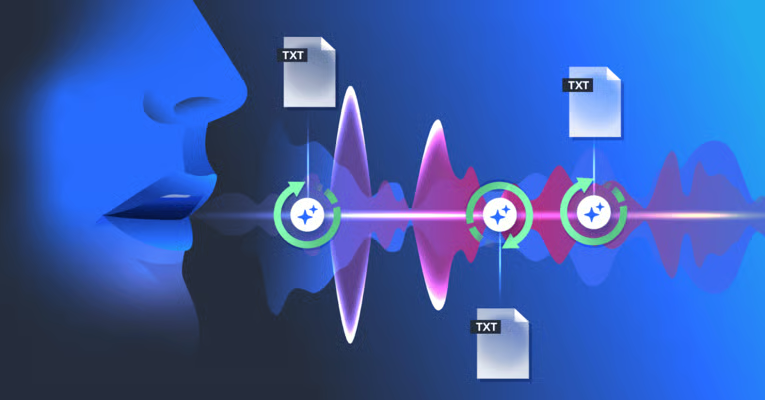
When we talk, sound waves containing layers of frequencies are produced. In ASR, we receive this audio information as input and convert it into sequences of numbers, a format that machine learning models understand. These numbers can then be converted into the required result, which is text.
Pedori: If you’ve ever heard a foreign language being spoken, it doesn’t sound like it contains separate words—it just strikes you as an unbroken wall of sound. Modern ASR systems are trained to take this wall of sound waves (in the form of wave files) and extrapolate the words from it.
Demir: Another very important thing is that the goal of automatic speech recognition is not to understand the intent of human speech itself. The goal is just to convert the data, or, in other words, to transform the speech into text. To use that data in any other way, a separate, dedicated system needs to be integrated with the ASR model.
Pedori: “Voice recognition” is a rather vague term. It’s often used to mean “speaker identification,” or the verification of who is currently speaking by matching a certain voice to a specific person.
We also have voice detection, which consists of being able to tell whether a certain voice is speaking. Imagine a situation where you have an audio recording with several speakers, but the person relevant to your project is only speaking for 5% of the time. In this case, you’d first run voice detection, which is often more affordable than ASR, on the entire recording. Afterward, you’d use ASR to focus on the part of the audio recording that you need to investigate; in this example, that would be the chunks of conversation spoken by the relevant person.
The main application of voice recognition in audio transcription is called “diarization.” Let’s say we have a speaker named John. When analyzing an audio recording, diarization identifies and isolates John’s voice from other voices, segmenting the audio into sections based on who is speaking at any given moment.
Mostly, voice recognition and ASR differ in how they treat accents. In ASR, to understand the words, you generally want to ignore accents. In voice recognition, however, accents are a great asset: The stronger the accent your speaker has, the easier they are to identify.